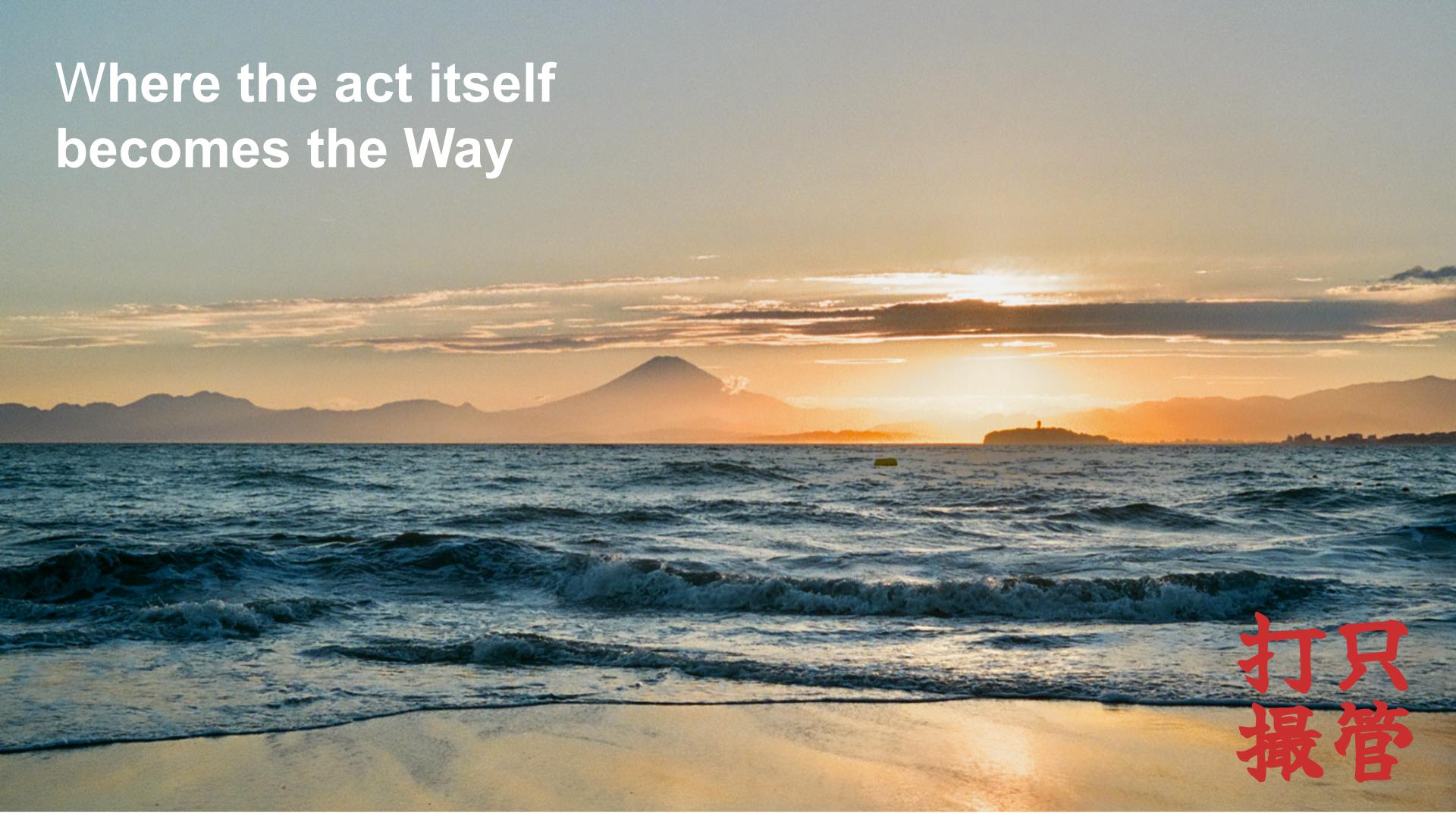
Only Doing the Act of Photographing — “Shikan-ta-satsu”
A Conceptual Statement from the Okazaki Optical Research Institute
In an age when images can be produced endlessly and without effort, we return to a more fundamental question:
What does it mean to photograph?
At the Okazaki Optical Research Institute, photography is not a method of documentation nor merely a visual practice.
It is an act of presence—
a moment in which time, memory, and inner perception intermingle in quiet depth.
Inspired by the Zen discipline of shikan-taza (“just sitting”),
we propose a parallel path of practice:
只管打撮 — Shikan-ta-satsu
“Only doing the act of photographing.”
This is not a technique, nor a style, nor a search for ideal images.
It is a way of being.
The Digital Tension — When Convenience Becomes Distance
Modern cameras—especially smartphones—perform astonishing feats:
autofocus, exposure, stabilization, computational enhancement.
Images now appear before intention fully forms.
This is undeniably a triumph of technology.
And yet, something essential has thinned:
- the tension between the world and the photographer
- the negotiation between body, light, and time
- the unpredictability through which meaning once emerged
- the spaciousness where memory quietly entered the frame
With speed came flatness.
With optimization came distance.
Photography now often lacks the temporal depth that once linked image-making with the inner life.
Mechanical Cameras as Yorishiro
Old mechanical cameras behave differently.
The resistance of the winding lever.
The breath that settles as the scene enters the finder.
The shy uncertainty of film—a delay that invites reflection rather than judgment.
These cameras function as Yorishiro:
vessels that invite what cannot be seen—
memory, atmosphere, forgotten sensation, emotional residue—
to inhabit the photographic moment.
Through this physical engagement:
- the outer world and the inner world begin to overlap
- time softens
- space thickens
- the act becomes an encounter
What remains is more than an image.
It is a moment that has entered the photographer,
as much as the photographer has entered the moment.
The Practice of Shikan-ta-satsu
Shikan-ta-satsu is photography as meditative discipline.
- Not seeking an outcome
- Not chasing beauty or technical success
- Not capturing in order to show
- But capturing in order to be
It is the quiet alignment of body, breath, and attention,
where the act itself is complete.
The device becomes a partner, not a tool.
The world becomes a dialogue, not a subject.
And the photograph becomes a trace of a moment of union.
Photography, stripped of ornament and ambition, returns to its root:
a gesture of seeing and being seen.
Why This Matters Now
During the global pandemic, the world was saturated with images—
sharp, instantaneous, optimized.
Yet these images lacked:
- time
- presence
- atmosphere
Mechanical photographs, by contrast, contain the thickness of lived experience.
They remind us that images are not mere visual data,
but repositories of memory.
In a world accelerating toward automation and abstraction,
Shikan-ta-satsu restores the human dimension of photography.
It is a practice of slowing down,
rediscovering one’s inner rhythm,
and reconnecting with the subtle beauty that appears only when the mind is still.
The Mission of the Okazaki Optical Research Institute
Our inquiry explores the intersection of:
- unexpected harmony
- reconstruction of temporal layers
- chiaroscuro as memory
- reconnection with personal and cultural history
We approach photography not as documentation,
but as a field of spiritual and sensory resonance
where the visible and the invisible quietly touch.
Through the study of vintage cameras, optical heritage, tactile processes,
and the emotional charge of images,
we seek new frontiers for photographic expression in the digital age.
A Return to the Act Itself
Shikan-ta-satsu is not nostalgia.
It is not anti-digital.
It is a return to the origin of the medium:
the act that transforms the photographer
before it transforms the world.
In this simple and deliberate gesture,
we rediscover a way of seeing that is also
a way of living.